API Integration
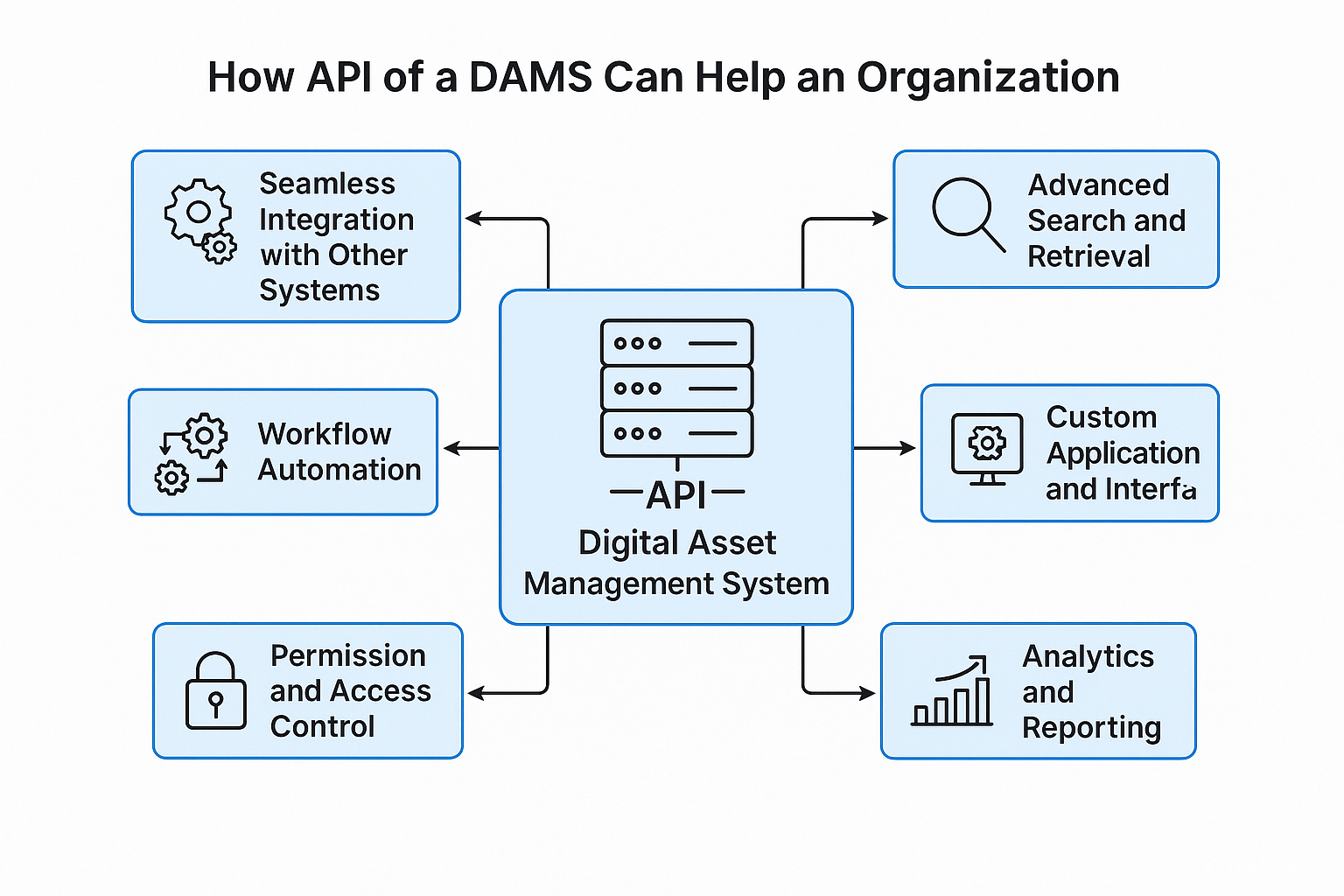
Smart Repository’s API is one of its strongest enablers for integration, automation, and scalability. Instead of treating the repository as an isolated system, APIs allow it to become part of a larger digital ecosystem.
Here’s how the API helps:
Seamless Integration with Existing Systems
Organizations often already use ERP, CRM, LMS, HRMS, or custom applications. Smart Repository’s API allows these systems to connect directly and exchange data.
Examples:
- A school’s LMS can fetch learning materials from Smart Repository
- An ERP can automatically archive invoices or reports
- A website can pull approved media assets dynamically
This avoids duplication and manual uploads.
Automated Document Ingestion
Files can be pushed into Smart Repository programmatically.
Instead of manually uploading documents:
- scanners can upload scanned files
- OCR pipelines can submit processed PDFs
- external systems can push newly generated reports
This is especially useful for high-volume environments like:
- libraries
- hospitals
- government offices
- educational institutions
Powerful Search from External Applications
Smart Repository’s search API allows other applications to leverage its indexing, metadata, OCR, and filtering capabilities.
That means users can search repository content from:
- intranet portals
- mobile apps
- third-party dashboards
- enterprise applications
Benefits:
- centralized search
- faster discovery
- consistent results everywhere
Metadata Synchronization
APIs allow external systems to read or update metadata.
For example:
- update document categories
- modify tags
- sync author information
- manage approval status
This ensures metadata remains consistent across systems.
Workflow Automation
Smart Repository APIs enable automation around approval and publishing workflows.
Examples:
- after approval, publish document automatically
- trigger notifications
- move assets between collections
- archive expired records
This reduces repetitive manual work.
Distributed Storage Access
Since Smart Repository supports multiple storage backends (local, FTP/SFTP, NFS, S3, Google Drive), APIs provide a unified interface to access content regardless of where it is physically stored.
Applications do not need to care whether the file lives in:
- local storage
- cloud storage
- remote servers
The API abstracts storage complexity.
Custom Frontends and Portals
Some organizations need highly customized interfaces.
Using APIs, developers can build:
- branded portals
- mobile apps
- public archives
- knowledge portals
- self-service dashboards
All powered by Smart Repository in the backend.
Analytics and Reporting
API endpoints can expose usage data such as:
- downloads
- searches
- popular documents
- access frequency
This helps administrators understand:
- what content is valuable
- what users search for
- where knowledge gaps exist
Future-Proof Architecture
API-first systems adapt better to future technology changes.
As new tools emerge—AI assistants, chatbots, automation platforms, knowledge agents—Smart Repository can integrate with them through APIs.
This makes the platform ready for:
- AI-powered search
- semantic discovery
- intelligent recommendations
- enterprise knowledge assistants
Smart Repository’s API transforms it from a document storage system into a programmable knowledge platform.
It enables: ✅ integration ✅ automation ✅ search everywhere ✅ custom applications ✅ scalable architecture
In short, the API ensures your knowledge is not trapped inside one application—it becomes available wherever your organization needs it.